


General Introduction
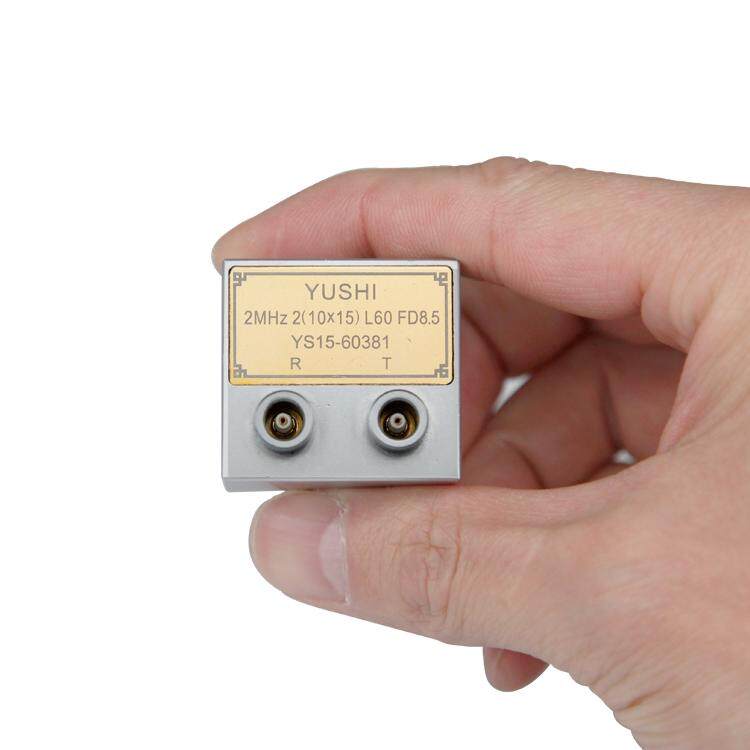
The YUSHI Longitudinal Dual-element Angle Beam Probe is often used where the straight beam testing struggles to find defects, for example, when the cracks are vertical and thin and thus not detectable because of small amount of reflection. This kinds of probes can be used for forgings and plates inspection. The operating principle of angle beam NDT lies in the conversion of a longitudinal (compression) wave sent by the transducer into a refracted shear (transverse) wave in the test sample.YUSHI can provide customers with various of frequency longitudinal probes and supply OEM service.
Composition of the Probe
An ultrasonic angle beam probe consists of an element such as a sound-absorbing material, a housing, a damping block, a wedge, and a piezoelectric element that generates ultrasound.
The operating principle of Angle Beam Probe
The electrical pulse generated by the ultrasonic instrument circuit is used to the wafer with piezoelectric effect, so that the piezoelectric wafer produces a reverse piezoelectric effect, and the wafer undergoes radial vibration in the axial direction and the vertical axis. The vibration direction of the wafer is the vibration direction of the ultrasonic particle, and the vibration direction of the particle is the same as the transmission direction of the ultrasonic sound beam, so it can be inferred that the useful sound beam generated by the axial vibration of the wafer is the longitudinal wave sound beam, and the ultrasonic sound velocity of the wedge block is the longitudinal wave sound velocity of plexiglass. The longitudinal wave sound beam generated by the wafer enters the workpiece through a wedge and couplant layer with a certain angle, and the sound beam undergoes waveform conversion at the contact interface between the couplant and the workpiece. When the longitudinal wave beam enters the workpiece at an angle less than the first critical angle, the sound beam of the workpiece is longitudinal wave and tranverse wave, and the angle of the longitudinal wave beam is greater than that of the tranverse wave. The angle of incidence is greater than the first critical angle and less than the second critical angle, and the sound beam of the workpiece is pure tranverse wave.

What is the function of Longitudinal Angle Beam Probe?
A longitudinal wave angle probe is a transducer with an angle of incidence less than the first critical angle. The purpose is to use the longitudinal wave at a small angle to test the defect, or to use the characteristics of the longitudinal wave with strong penetration ability to carry out the longitudinal wave oblique incidence test when the shear wave attenuation is too large.

The Advantages of Angle Beam Probe
1.High sensitivity
2.Less clutter
3.Small blind spots

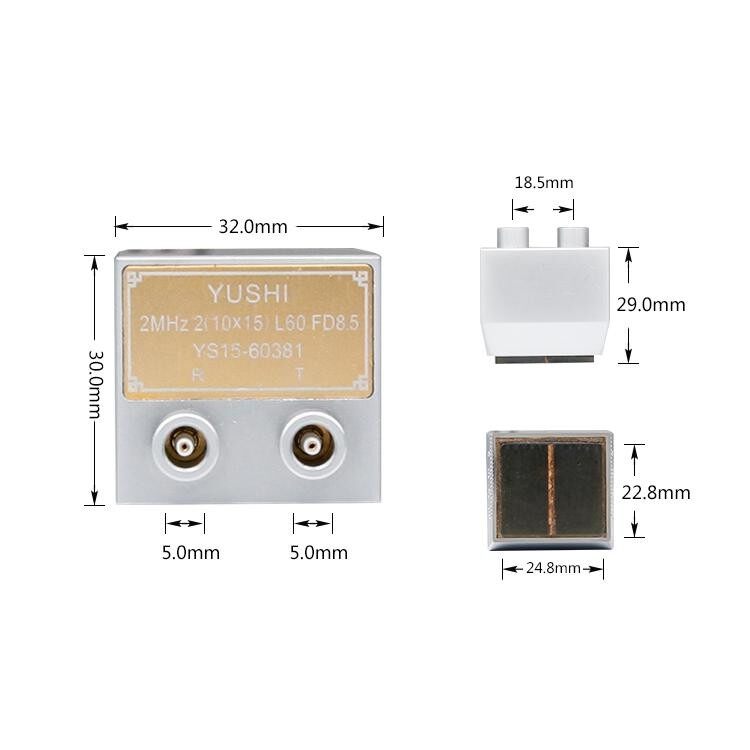
Probe Specification


Customizations


