

General Introduction
YUSHI PRmini Ultrasonic Pulser-Receiver is an ultrasound systems that can be applied to UT gauges. Its unique working principles can provide users with effiecient accurate guidance. The equipment is widely used across various industries, including aerospace, automotive, and machinery manufacturing, achieving fast and precise ultrasonic testing, thickness measurement, and probe detection technologies. The pulser receiver includes control software based on the Windows platform, allowing the selection of trigger sources, transmission voltage, repetition frequency, and pulse width, as well as switching between single and dual crystal modes, and adjusting damping and gain to meet different requirements. Users can utilize the open SDK (Software Development Kit) to develop custom software on various mainstream Windows systems.

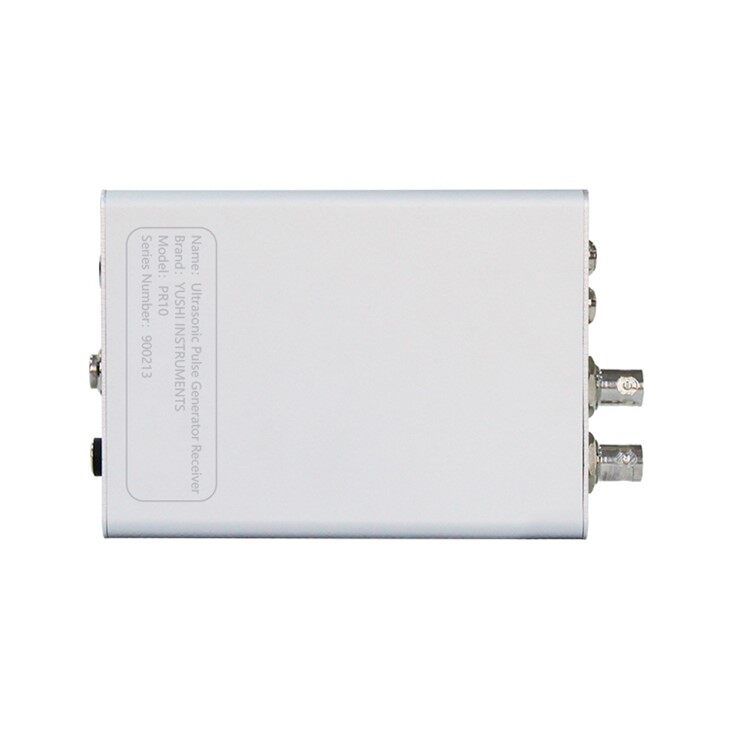
The Composition of PRmini
- 2 BNC connectors (Q9 interfaces): one is the signal output interface for connecting to an oscilloscope to display the received waveform; the other is the input end for external triggering.
- 2 C5 interfaces: single crystal probe connection interface (T/R), dual crystal probe requires two interfaces (T/R and R);
- 1 half-moon communication interface: Connect to computer via USB - 4-core half-moon data cable
- 13.5*1.35DC power interface: connect to a 5V 1A power adapter.
Control Software of PRmini
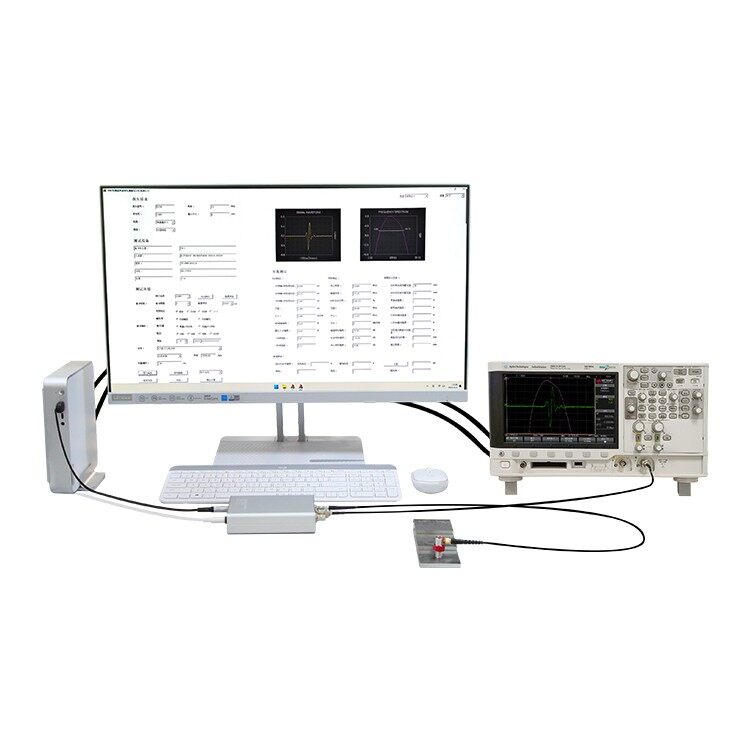
The interface of the ultrasonic pulse transmitter receiver control software is shown as follows:

1.Emission Area Parameters
•Emission Voltage
There are 4 emission voltages, 60V, 110V, 150V, 200V optional (when the damping is 34Ω, 200V emission voltage can not be adjusted), which is used to select the required pulse amplitude.
•Pulse Width
The pulse width can be adjusted from 1 to 40 times (1 times about 28ns).
•Repetition Frequency
The repetition frequency is the number of ultrasonic pulses emitted per second when the instrument is used as a generator, with 4Hz, 8Hz, 16Hz, 20Hz, 100Hz, 500Hz, 1kHz, 2kHz eight gears to choose from to meet different applications.
•Trigger Source
Trigger source can be selected internal trigger and external trigger, when the internal trigger is selected, the instrument itself is used as the ultrasonic pulse generator, when the external trigger is selected, it needs to be connected to a special device or signal generator.
2.Receiving Area Parameters
The receiver parameters are used to control the ultrasonic pulse receiver.
•Single/Twin Crystals
The instrument supports pulse echo mode and one- transmit one- receive mode.
Single crystal represents pulse echo mode, pulse transmission and echo reception through interface 1; The twin crystals represent one- transmit one- receive mode, transmitting pulses through interface 1 and receiving through interface 2.
•Damping
Damping has 34Ω, 50Ω, 90Ω, 510Ω four gears.
•Gain
Gain control the amplification and attenuation of the received signal, the selection range from -4dB to 55dB, can be adjusted by sliding, or adjusted by 1dB step-by-step, can meet the requirements of the most applications.
Where can Ultrasonic Pulser Receiver be used for?
1.The analysis of UT Probes
UT probes play very important role in ultrasonic testing. The performance of the probe directly affects the accuracy and reliability of the results. Use PR10 Ultrasonic Pulser Receiver can make the time and frequency domain responses of the signal from the probe be measured and analyzed during operation.
2.Ultrasonic wall thickness measurement and flaw detection
The principle of ultrasonic pulse reflection is used to measure and analyze the waveform. Flaw detection is used to determine the presence, size, and location of a defect. Thickness measurements, on the other hand, are obtained by knowing the velocity of sound of the material and the time interval between two bottom echoes, which makes it possible to calculate the thickness of the workpiece.
3.Material analysis
Using the principle of ultrasonic pulse reflection, the mechanical properties and quality of the material are evaluated by measuring the speed at which ultrasonic waves propagate through the material. It is widely used in the field of materials engineering, especially in materials evaluation and quality control.

An useful module for probes detection
Working Principle
By performing fast Fourier transform on the echo signal of the ultrasonic pulse, its spectrum is obtained, thereby determining its center frequency and comparing it with the nominal frequency of the probe to achieve the purpose of probe detection.
Ideal testing platform for thickness measurement
Working Principle
The waveform is measured using the principle of ultrasonic pulse reflection, and the thickness of the workpiece can be obtained by calculation. Users just connect the instrument to the power supply and connect the probe to the instrument interface. Then they can adjust the measuring paraments on the PC.

The Reasons for Trusting YUSHI PR10
Replace the traditional Pulser Receiver
- Small in size,light in weight;
- Easy to operate;
- Comprehensive functions;
- Reliable using performance;
- Greatly reduce users' instrument cost.
Control software for Windows platform
- No need for additional equipment. Can directly run the executable file on Window system.
- Allow users to set and store parameters according to their needs, and later retrieve the file for use.
Building ideal testing platform
- Easy to connect with oscilloscope and display the received waveform;
- Can work with the control software on the PC;
- Applied to ultrasonic flaw detection, material thickness measurement, probe characterization analysis, and special material performance analysis.


Maintenance and Repair
- Strict collision avoidance, during the use and storage of the instrument, pay attention to dust, moisture, acid and alkali substances.Please keep the devices away from strong electromagnetic fields.
- Please do not disassemble or repair without the help of personnels,since the devices are high-tech products.
- If there is any quality problem, please contact the manufacturer.
Our address
U39, No. 81-43, Puhe Road, Hushitai Street, Shenbei New District, Shenyang, Liaoning, China 110136
Phone Number
+86 18240322476
sales02@yushindt.com

| Pulse Type | Control Paraments | ||
| Rise Time | Emission voltage | ||
| Fall Time | Pulse Width | ||
| Pulse Width | Repetition Rate | ||
| Band Width | Trigger Source | ||
| Receiving Area |
0.5-20MHz |
||
| Excitation mode |
Pulse-echo (P-E), Penetration (T-T) |
||
| Repetition frequency |
Internal trigger: 4Hz-2kHz; External trigger: 0-20kHz |
||
| External trigger |
Rising edge trigger; Trigger voltage: 3.3V |
||
Note:
1.Choosing the higher emission voltage will result in longer fall time and rise time.
2: The wider the pulse width, the smaller the emission voltage.
3:As the repetition rate increases, the emission voltage will also decrease slightly.
| Control Paraments | Range | Stepping | |
| Launch Area | Emission voltage |
60V,110V,150V,200V |
Chose |
| Pulse Width |
1~40(one time is approximately 28ns) |
One time | |
| Repetition Rate |
4Hz,8Hz,16Hz,20Hz,100Hz,500Hz,1kHz,2kHz |
Chose | |
| Trigger Source | Internal trigger,External trigger | Chose | |
| Receiving Area | Single/Twin Crystal |
single crystal(1T/1R),twin crystal(1T/2R) |
Chose |
| Damping |
34Ω,50Ω,90Ω,510Ω |
Chose | |
| Gain |
-4dB~55dB |
1dB |
| Power Supply | DC:5V1A | Operating temperature | 0-55℃ |
| Outline Size |
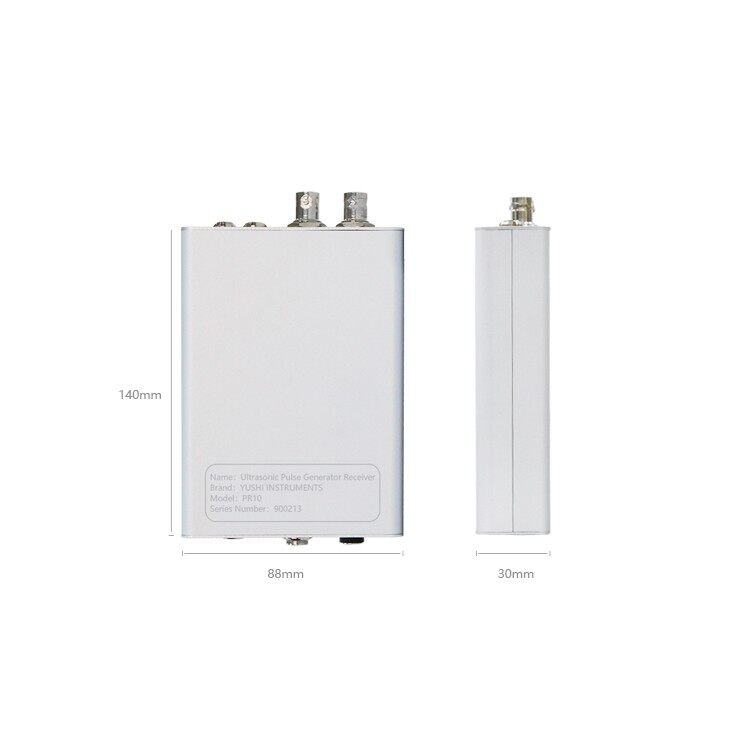
14cm*8.8cm*3cm |
Weight | 230g |
| Host machine PR10 | 1 | Connecting lineC9-Q9 | 2 |
| Data line USB-4 core | 1 | Power adapter | 1 |
| Communication USB flash disk | 1 | Control software | 1 |


