

Foreword
Metal composites, often referred to as bimetallic or cladding tubes, are composite tubes consisting of two different metal tubes. They are made using composite technology or a variety of metals with different chemical and mechanical properties to achieve metallurgical bonding at the interface. The composite material formed greatly improves the thermal expansion, strength, fracture toughness, impact toughness, abrasion resistance, electrical properties, magnetic properties and many other properties of a single metal material. As a new type of structural Materials, composite pipe has been widely used in petroleum, chemical, shipbuilding, metallurgy, mining, machinery manufacturing, electric power, water conservancy, transportation, environmental protection, pressure vessel manufacturing, food, brewing, pharmaceuticals and other industrial fields.

It is very necessary to carry out regular non-destructive testing of bimetallic composite pipes. In the past, in the actual engineering, it is usually measured directly at the two ends of the composite pipe using tools such as vernier calipers. Sometimes, in order to meet the needs of users, samples are randomly taken and cut longitudinally before measurement, resulting in waste.
In order to solve this problem, we need to use ultrasonic thickness measurement technology for research and measurement, which can accurately measure the wall thickness of the bimetallic composite pipe.
This is of great significance to ensure the strength of the bimetallic composite pipe and to assess its safety and service life.
Tested Samples

We received a sample from our customer of a bimetallic composite material with an upper layer of 20 gauge steel and an inner layer of 304 stainless steel. This material utilizes explosive composite technology to bond the surfaces of the two metals together. Since the thickness of the 304 stainless steel liner for corrosion protection is only about 3 millimeters, we conducted several comparison tests to improve the precision and accuracy of our measurements.
About Testing Instruments
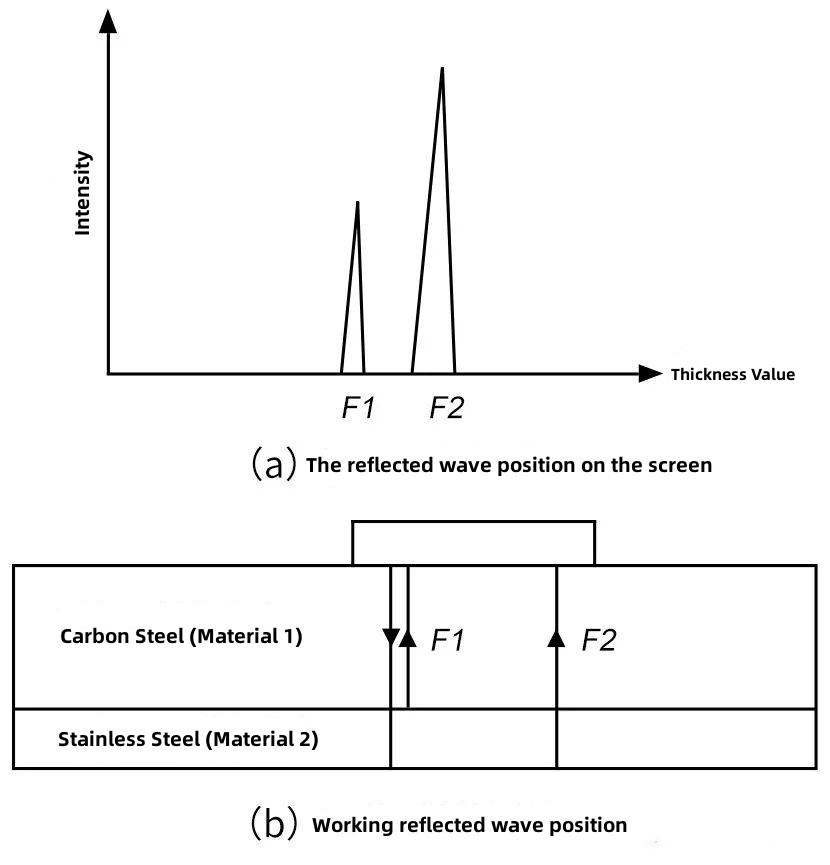
The wall thickness of (11.2+2.7) mm 20# steel + 304 stainless steel bimetallic composite sample was measured using a conventional ultrasonic thickness gauge. It was found that when the thickness was measured at the same point, sometimes it showed the thickness of the outer layer and sometimes it showed the thickness of the whole, which is a very common phenomenon in the inspection of composite pipes. This is because the inner and outer metal materials of the bimetallic composite are different. 20# steel and 304 stainless steel have similar acoustic impedance. Although the interface reflection wave can be observed, the reflection wave is very weak, and the interface reflection characteristic of the measurement point is not obvious.
So we used PM5 Gen2 Ultrasonic Thickness Gauge with Delay Line Probe to finish this measurement case. Here we adapted one of powerful software functions of PM5 Gen2:Double-layer measurement mode.
Measurement Analysis
The thickness of each layer is calculated based on the speed of sound and echo arrival time, so the accuracy of the speed of sound is directly related to the measurement accuracy. The speed of sound cannot be simply applied to the speed of sound of a certain material, but needs to be determined by test blocks of various materials, and then accurately converted according to the propagation time of sound waves in each layer.
Measurement Results
YUSHI PM5 Gen2 ultrasonic thickness gauge using high-frequency probe to measure the wall thickness of 20# steel +304 stainless steel bimetallic composite material, can simultaneously measure the thickness of 2 layers of the material and the total thickness of the material, the echo is clear, stable and accurate measurement value.
