

Can a Portable LED UV NDT Lamp be used for flaw detection in welds?
As a supplier of Portable LED UV NDT Lamps, I am often asked whether our lamps can be effectively used for flaw detection in welds. Weld flaw detection is a critical process in various industries, including manufacturing, construction, and aerospace, as it ensures the integrity and safety of welded structures. In this blog post, I will explore the feasibility and effectiveness of using a Portable LED UV NDT Lamp for weld flaw detection.
Understanding Weld Flaw Detection
Welds are used to join two or more pieces of metal together, and they are subjected to various stresses and loads during their service life. Flaws in welds, such as cracks, porosity, lack of fusion, and incomplete penetration, can compromise the strength and durability of the welded structure, leading to potential failures and safety hazards. Therefore, it is essential to detect these flaws before the structure is put into service.
There are several non - destructive testing (NDT) methods available for weld flaw detection, including visual inspection, ultrasonic testing, radiographic testing, magnetic particle testing, and liquid penetrant testing. Each method has its own advantages and limitations, and the choice of method depends on factors such as the type of weld, the material being welded, the size and location of the flaw, and the required level of sensitivity.
How Portable LED UV NDT Lamps Work
Portable LED UV NDT Lamps emit ultraviolet (UV) light in the range of 365 - 375 nanometers, which is commonly referred to as long - wave UV or black light. When this UV light illuminates a surface that has been treated with a fluorescent penetrant or magnetic particle suspension, the fluorescent material in the penetrant or suspension absorbs the UV light and emits visible light, making the flaws on the surface visible to the inspector.
The use of LED technology in these lamps offers several advantages over traditional UV lamps. LEDs are more energy - efficient, have a longer lifespan, and produce less heat. They also provide a more stable and consistent UV output, which is crucial for accurate flaw detection.
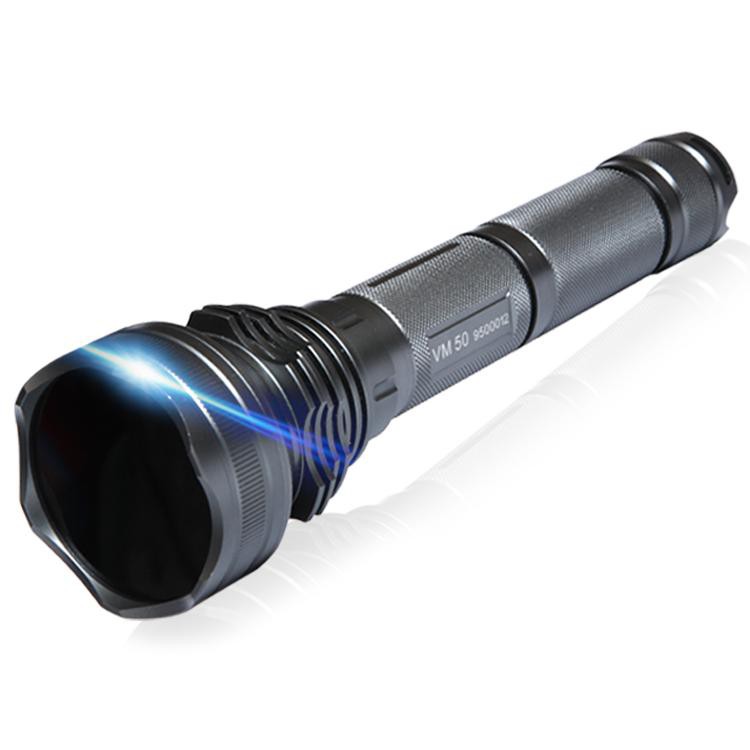

Application of Portable LED UV NDT Lamps in Weld Flaw Detection
One of the most common NDT methods for weld flaw detection where Portable LED UV NDT Lamps can be used is liquid penetrant testing (LPT). In LPT, a liquid penetrant is applied to the surface of the weld. The penetrant seeps into any surface - opening flaws, such as cracks or porosity. After a sufficient dwell time, the excess penetrant is removed from the surface, and a developer is applied. The developer draws the penetrant out of the flaws, and when the surface is illuminated with a Portable LED UV NDT Lamp, the fluorescent penetrant in the flaws glows brightly, making them easily visible.
Another application is in magnetic particle testing (MPT) for ferromagnetic materials. In MPT, a magnetic field is applied to the weld area, and magnetic particles are then sprinkled or sprayed onto the surface. If there is a flaw in the weld, the magnetic field is distorted at the location of the flaw, and the magnetic particles accumulate at the flaw site. When illuminated with a Portable LED UV NDT Lamp, the fluorescent magnetic particles highlight the flaws.
Advantages of Using Portable LED UV NDT Lamps for Weld Flaw Detection
- Portability: As the name suggests, Portable LED UV NDT Lamps are lightweight and easy to carry, making them suitable for on - site inspections. They can be used in various locations, including construction sites, manufacturing plants, and even in remote areas where access to power sources may be limited. For example, if you need to inspect welds on a large bridge structure, you can easily move the lamp around to different areas of the welds.
- High Sensitivity: These lamps can detect very small flaws in welds, down to a few micrometers in size. This high level of sensitivity is crucial for ensuring the quality and safety of the welded structures, especially in industries where even the smallest flaw can have significant consequences.
- Quick Results: The inspection process using a Portable LED UV NDT Lamp is relatively quick. Once the penetrant or magnetic particle application and removal steps are completed, the inspector can immediately start looking for flaws under the UV light. This saves time compared to some other NDT methods, such as radiographic testing, which may require longer processing times.
- Cost - Effective: LED technology is becoming more and more affordable, and Portable LED UV NDT Lamps have a lower cost of ownership compared to traditional UV lamps. They consume less energy, have a longer lifespan, and require less maintenance, which makes them a cost - effective option for weld flaw detection.
Limitations and Considerations
While Portable LED UV NDT Lamps offer many advantages for weld flaw detection, there are also some limitations and considerations to keep in mind.
- Surface Condition: The effectiveness of the flaw detection depends on the surface condition of the weld. If the surface is dirty, rough, or has a thick layer of paint or coating, it may interfere with the penetrant or magnetic particle application and the detection of flaws. Therefore, proper surface preparation is essential before using the lamp for inspection.
- Depth of Flaws: Portable LED UV NDT Lamps are mainly suitable for detecting surface - opening flaws. They may not be able to detect subsurface flaws that are located deep within the weld. For detecting subsurface flaws, other NDT methods such as ultrasonic testing or radiographic testing may be more appropriate.
- Operator Training: To ensure accurate and reliable results, the inspector using the Portable LED UV NDT Lamp needs to be properly trained. They should be familiar with the NDT method being used, the correct application of the penetrant or magnetic particles, and the interpretation of the test results.
Conclusion
In conclusion, Portable LED UV NDT Lamps can be effectively used for flaw detection in welds, especially for surface - opening flaws using liquid penetrant testing or magnetic particle testing. Their portability, high sensitivity, quick results, and cost - effectiveness make them a valuable tool for weld inspection in various industries. However, it is important to consider the limitations and ensure proper surface preparation and operator training to achieve accurate and reliable results.
If you are interested in learning more about our Portable LED UV NDT Lamp or our Handheld LED UV NDT Lamp for weld flaw detection, please feel free to contact us for a detailed discussion and to explore potential procurement opportunities. We are committed to providing high - quality NDT solutions to meet your specific needs.
References
- ASNT (American Society for Nondestructive Testing). Nondestructive Testing Handbook, Volume 1: Ultrasonic Testing.
- ISO standards related to non - destructive testing of welds, such as ISO 17636 - 1:2013 (Radiographic testing of welds - Part 1: Acceptance levels for steel, nickel, titanium and their alloys).
- AWS (American Welding Society) documents on weld inspection and quality control.